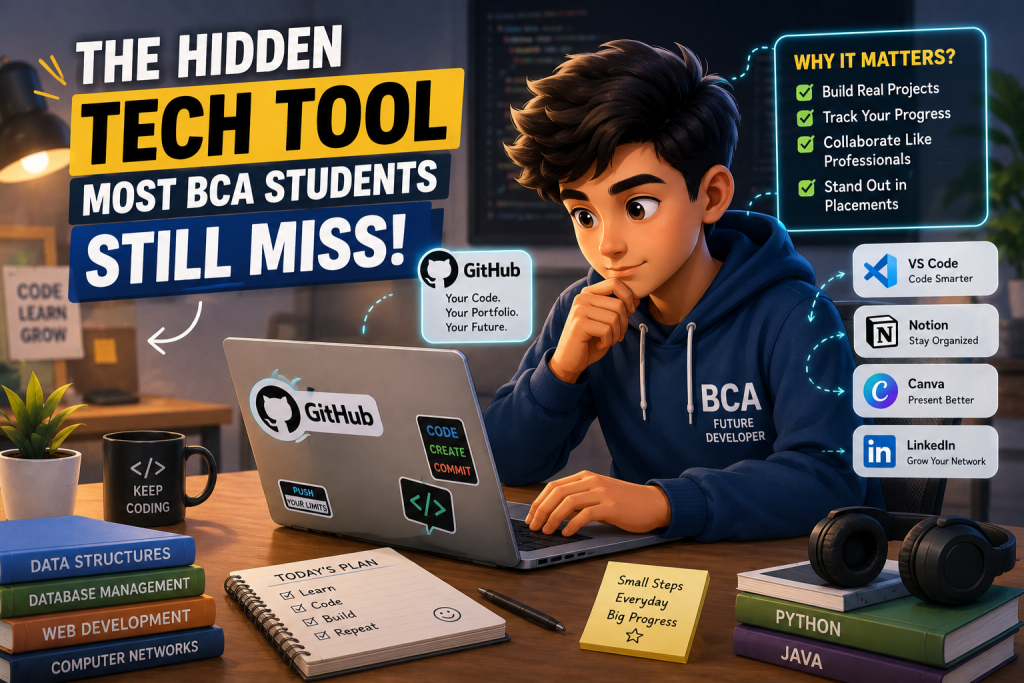
Exploring how BCA education in Patna can connect classroom learning with practical skills and career opportunities.
For students interested in computers, software, technology and digital careers, Bachelor of Computer Applications (BCA) can be a practical starting point after Class 12.
But choosing a BCA course is about more than selecting a college and completing a degree. The technology industry is changing quickly, and employers increasingly value graduates who can combine academic knowledge with practical skills, communication, problem-solving and an understanding of how technology is used in the workplace.
This makes the choice of BCA colleges in Patna an important decision.
Students need to look beyond the classroom and ask a bigger question:
What will I actually learn, build and experience during my BCA journey—and where can it take me afterwards?
Patna has several institutions offering computer applications and IT-related education. Their approaches can differ in terms of practical learning, infrastructure, industry interaction, placement preparation and student development.
Among these, CIMAGE College has developed a career-oriented learning environment that places considerable emphasis on practical exposure, technology and professional preparation.
This article explores what students can expect from BCA education in Patna and the factors worth considering before choosing a college.
Why Choose BCA After Class 12?
BCA is designed for students who want to build a foundation in computer applications and information technology.
Depending on the university and programme structure, students may encounter areas such as:
- Programming
- Database management
- Web technologies
- Computer networks
- Software development
- Data structures
- Computer systems
- Data analytics
- Artificial intelligence
- Cloud technologies
The degree can provide a foundation for both employment and further education.
After BCA, students may explore careers in areas such as:
- Software development
- Web development
- IT support
- Data analytics
- Cloud computing
- Cybersecurity
- Business analysis
- Application development
- Digital technology
- Technology-enabled business roles
Some students also continue their education through programmes such as MCA, MBA, specialised certifications or other postgraduate programmes.
However, the degree itself is only one part of the journey.
The skills developed during those three years can make a significant difference.
BCA Education Is Changing
The technology industry that students enter after graduation may look very different from the one that existed a decade ago.
Artificial intelligence, cloud computing, data analytics, cybersecurity, automation and digital platforms are increasingly influencing businesses.
Technology is also no longer restricted to traditional IT companies.
Banks, retail companies, healthcare organisations, consulting firms, educational institutions, manufacturing companies and startups all depend on technology.
This means BCA students need to think beyond simply learning programming languages.
They should gradually develop the ability to:
understand → practise → build → communicate → solve problems
That is where the learning environment of a college becomes important.
What Should Students Look for in a BCA College in Patna?
There is no single factor that determines whether a BCA college is right for every student.
Instead, students should consider several aspects together.
1. Academic Foundation
The first priority should always be academics.
Students should understand what the programme teaches and whether the curriculum provides a strong foundation in computer applications and related areas.
But the syllabus is only part of the picture.
Students should also consider:
- How classes are conducted
- How practical work is integrated
- How projects are mentored
- Whether students can interact with faculty
- How academic performance is assessed
- Whether students receive guidance when they face difficulties
A good academic environment should encourage students to understand concepts rather than simply prepare for examinations.
2. Practical Learning Beyond the Classroom
One of the biggest differences between school-level education and professional education is the opportunity to apply what has been learned.
A BCA student can study programming concepts in a classroom.
But building a small application, developing a website, working with a database or completing a group project creates a different kind of understanding.
Practical learning can include:
- Coding projects
- Web development
- Database assignments
- Software projects
- Data analysis
- Technical workshops
- Hackathons
- Group projects
- Technology demonstrations
When evaluating a college, students should ask:
“What do BCA students actually build?”
That question can reveal much more than simply asking whether the institution has a computer lab.
CIMAGE College: Connecting BCA Learning With Practical Exposure
Within Patna’s professional education landscape, CIMAGE College has built an educational environment with a strong focus on career preparation, practical learning and technology exposure.
Its broader institutional ecosystem includes computer laboratories, smart classrooms, technology-oriented learning, workshops, industry interaction, projects and skill-development activities.
The approach is intended to connect classroom concepts with practical applications.
For a BCA student, this can mean opportunities to move beyond textbook-based learning and explore how technology works in real-world situations.
The broader CIMAGE ecosystem also provides exposure to areas associated with the changing technology landscape, including AI, IoT, robotics, data analytics and cloud-related learning.
The important consideration for students, however, is not simply the presence of these facilities or activities.
It is whether students actively participate in them.
A technology lab becomes valuable when students use it.
A workshop becomes useful when students learn something they can apply.
A project becomes meaningful when students understand how and why it works.
That distinction is important when comparing any BCA college.
Technology Exposure During BCA
Technology changes quickly.
A student entering BCA today may encounter technologies and career paths that were not mainstream when many parents were in college.
Areas such as:
- Artificial Intelligence
- Machine Learning
- Cloud Computing
- Data Analytics
- Cybersecurity
- Internet of Things
- Robotics
- Automation
are increasingly relevant to modern organisations.
Students do not need to become experts in all of these areas.
Instead, early exposure can help them understand what interests them and where they may want to specialise later.
For example, a student who enjoys working with data may explore analytics.
Someone interested in systems may move towards cloud computing or cybersecurity.
Another student may enjoy application development or AI.
A good BCA experience should give students enough exposure to discover these possibilities.
Industry Exposure: Understanding How Technology Works in the Real World
Classroom learning explains concepts.
Industry exposure helps students understand context.
Guest lectures, workshops, expert sessions, industrial visits and internships can help students understand:
- How companies use technology
- What employers expect from graduates
- What professional roles actually involve
- Which skills are becoming important
- How teams work
- How projects are managed
CIMAGE’s educational approach includes industry interaction, workshops, expert sessions and industrial visits as part of its broader professional learning environment.
The value of such activities, however, should be judged by their learning outcomes rather than simply by the number of events conducted.
A meaningful industry session should leave students with a better understanding of the workplace and the skills they need to develop.
Internships: Turning Learning Into Experience
An internship can be one of the most useful experiences during a BCA programme.
It gives students a chance to experience a professional environment before graduation.
For a BCA student, relevant internship experience might involve:
- Software development
- Web development
- Testing
- IT support
- Data analytics
- Business technology
- Cloud-related work
- Digital platforms
Students should not judge internships only by the name of the organisation or the certificate received.
The more useful questions are:
What did I actually work on?
What skills did I develop?
Did I receive guidance?
Can I explain the work in an interview?
These experiences can later become valuable additions to a resume and portfolio.
Placement Preparation: More Than a Placement Day
For many students, placements are an important reason for choosing a professional college.
But placement preparation should ideally begin well before the final semester.
Students may need preparation in:
- Quantitative aptitude
- Logical reasoning
- Verbal ability
- Communication
- Group discussions
- Interviews
- Resume preparation
- Professional etiquette
- Technical assessments
CIMAGE has a structured career-oriented environment that includes placement preparation and skill development.
The institution’s broader recruitment ecosystem has also been reflected in publicly visible alumni data.
However, students should understand an important distinction:
A placement opportunity is not the same as a placement guarantee.
A college can provide training, eligibility and access to recruitment opportunities.
Selection ultimately depends on the student’s performance, skills and eligibility.
What Does Alumni Data Tell Us?
Placement advertisements generally focus on recent recruitment.
Alumni data can provide another perspective by showing where graduates have gone over time.
The public LinkedIn research available for several Patna institutions shows an interesting pattern.
Among the institutions for which comparable LinkedIn employer data was publicly visible, CIMAGE showed a particularly high concentration of alumni at TCS and Wipro.
The available figures indicated approximately:
| Institution | TCS Alumni | Wipro Alumni |
|---|---|---|
| CIMAGE | 7.61% | 7.79% |
| Magadh Mahila College | 2.96% | 1.48% |
| Arcade Business College | 1.74% | 2.01% |
| Patna Women’s College | 1.17% | 1.01% |
| Amity University Patna | 1.35% | 1.25% |
These figures represent publicly visible LinkedIn alumni data and can change over time. They should therefore be treated as an indication of alumni concentration rather than as an official placement ranking.
The research also found that Patna Women’s College and Magadh Mahila College have broader and more diversified alumni footprints, while Amity University Patna has a younger alumni base.
This highlights an important point:
Different colleges can have different strengths.
A strong concentration of alumni in large IT companies can indicate a strong corporate employment pipeline.
A broader alumni network can indicate career diversity across sectors and professions.
Students should consider which pattern is more relevant to their own goals.
What About Other BCA Colleges in Patna?
CIMAGE is not the only institution students may consider.
Patna has several colleges and institutions with computer applications, IT and related programmes.
For example, students may also research institutions such as:
- Patna Women’s College
- Magadh Mahila College
- Arcade Business College
- Amity University Patna
- Other colleges offering computer application or IT-related programmes
Each institution has its own academic structure, facilities, student environment and career opportunities.
For example, the available alumni research indicates that Patna Women’s College has a larger and more diversified alumni base, while Magadh Mahila College shows a notable combination of banking and IT-sector representation.
Arcade Business College also shows a visible presence of alumni in companies such as TCS, Wipro, Genpact and Bajaj Finserv.
These differences make direct “best college” rankings difficult to justify.
The more useful approach is to compare colleges according to the factors that matter to you.
Skills Matter Alongside the BCA Degree
A degree provides a qualification.
Skills help students use it.
For BCA students, some useful areas to develop during college include:
Technical Skills
- Programming
- Database management
- Web development
- Data analysis
- Software development
- Cloud fundamentals
- Cybersecurity awareness
- AI and emerging technologies
Professional Skills
- Communication
- Teamwork
- Presentation
- Problem-solving
- Time management
- Interview skills
- Professional writing
Students do not need to master everything at once.
The goal should be gradual development.
A student who builds one meaningful project every year, participates in practical activities and improves communication skills alongside academics can graduate with a much stronger profile than someone who focuses only on semester examinations.
Projects Can Make a Difference
Projects are one of the easiest ways for students to demonstrate what they have learned.
A project could be something relatively simple at first:
- A website
- A database application
- A basic mobile application
- A data-analysis project
- An automation tool
As students progress, projects can become more complex.
The important thing is that students should be able to explain:
What problem did the project solve?
What technology did I use?
What challenges did I face?
What did I learn?
These questions can also become useful during interviews.
Communication Skills Are Important for IT Careers
There is a common misconception that IT careers are purely technical.
In reality, many technology professionals work in teams, communicate with clients, participate in meetings and explain technical information to people from non-technical backgrounds.
A developer may need to explain a feature.
A business analyst may present findings.
A project team may discuss deadlines.
A technical support professional may communicate with customers.
This is why presentations, group discussions, seminars and teamwork can complement technical education.
CIMAGE’s emphasis on skill development, communication and professional preparation reflects this broader understanding of employability.
BCA and Career Growth: What Happens After Graduation?
BCA can open several possible career directions.
Depending on their skills and interests, graduates can explore roles such as:
Software and Web Development
Students with strong programming and project skills may pursue development-related roles.
Data and Analytics
Students interested in numbers, patterns and business information can explore data-related careers.
Cloud and Infrastructure
Those interested in systems and technology infrastructure can build skills in cloud platforms and related areas.
Cybersecurity
Students interested in security can explore areas such as network security, application security and cybersecurity operations.
Business and Technology Roles
BCA graduates can also explore roles where technology and business overlap, particularly after developing communication and analytical skills.
Higher Education
Students may choose postgraduate study, including MCA or management-oriented programmes, depending on their career goals.
The important point is that BCA does not lead to only one career.
The direction you take depends heavily on the skills you build during and after the degree.
Why Alumni Career Progression Matters
A first job is only one point in a career.
Graduates may change companies, gain certifications, specialise in a technology or move into managerial roles over time.
The available research found examples of alumni from Patna institutions progressing into organisations and roles associated with companies such as Microsoft, Amazon, PwC, KPMG, Coforge and HSBC.
These examples should not be interpreted as direct campus placement claims.
Instead, they demonstrate something more useful:
A graduate’s career can continue developing long after the first placement.
For students choosing a BCA college, this means alumni outcomes can be worth examining alongside immediate placement statistics.
How Should Students Compare BCA Colleges in Patna?
Instead of creating a simple ranking, students can use a practical framework.
| Factor | What to Check |
|---|---|
| Academics | Curriculum, faculty and teaching approach |
| Practical learning | Projects, assignments and lab work |
| Technology | Relevant technology exposure |
| Industry | Workshops, experts and industrial visits |
| Internships | Opportunities and practical experience |
| Placements | Recruiters, roles and preparation |
| Alumni | Career paths and employer diversity |
| Infrastructure | Labs, library and learning spaces |
| Student development | Communication, teamwork and activities |
| Fees | Total cost and overall value |
This approach allows students to make a decision based on evidence rather than simply choosing the institution with the most visible marketing.
Questions to Ask Before Choosing a BCA College
Before taking admission, students can ask the college:
How much practical learning is included in the programme?
What projects do BCA students complete?
How frequently are computer laboratories used?
What technology workshops are available?
Are internships facilitated?
Which companies recruit BCA students?
What job roles are generally offered?
How does placement preparation work?
What do alumni do after graduation?
What is the complete cost of the programme?
And, perhaps most importantly:
Can I visit the campus and speak with current students?
A campus visit can sometimes answer questions that a website cannot.
Choosing a BCA College Is a Personal Decision
There is no universal formula for selecting a college.
A student who wants to become a software developer may prioritise programming, projects and technical labs.
A student interested in data analytics may look for exposure to data tools and analytical projects.
Another student may want to combine technology with business and later move towards management, analytics or entrepreneurship.
This is why the phrase “best BCA college in Patna” can be misleading when treated as a universal ranking.
The better question is:
“Which BCA college provides the learning environment and opportunities that match my career goals?”
Final Takeaway
A BCA degree can be a starting point for a career in a technology-driven world, but the value of the experience depends on much more than the degree certificate.
Students should look for an environment that combines:
Academic learning + practical projects + technology exposure + industry interaction + professional skills + career preparation.
CIMAGE College is one example in Patna where these elements are brought together through a career-oriented educational environment, practical learning, technology exposure, industry interaction and placement preparation.
At the same time, other institutions in Patna offer their own strengths, including broader or more established alumni networks and different academic environments.
The right decision, therefore, should not be based on a single ranking, package or advertisement.
Look at what students actually learn. Look at the opportunities they receive. Look at where alumni progress. And most importantly, choose a college that matches the kind of career you want to build.
Frequently Asked Questions
1. Is BCA a good career option after Class 12?
BCA can be a useful starting point for students interested in computers, software and technology. Career outcomes depend on the skills, projects, internships and further learning a student develops alongside the degree.
2. What should I look for in a BCA college in Patna?
Consider academics, faculty, practical learning, computer laboratories, technology exposure, industry interaction, internships, placement preparation, alumni outcomes and total fees.
3. Is practical learning important in BCA?
Yes. Practical projects and laboratory work help students apply programming and computer concepts to real problems.
4. What careers can I pursue after BCA?
Depending on your skills, you can explore software development, web development, data analytics, cloud computing, IT support, cybersecurity, business technology and other technology-related roles.
5. Is placement guaranteed after BCA?
No college can guarantee that every student will receive the same job or salary. Colleges can provide training and recruitment opportunities, but selection depends on eligibility and student performance.
6. Why should I consider alumni while choosing a college?
Alumni can provide a longer-term view of career outcomes. Looking at where graduates work and how their careers develop can complement recent placement information.
7. Is CIMAGE College an option for BCA in Patna?
CIMAGE College is one of the institutions students can consider when researching BCA education in Patna, particularly if they are interested in practical learning, technology exposure, industry interaction and career preparation.
8. Should I compare multiple BCA colleges before admission?
Yes. Comparing two or three institutions can help students understand differences in curriculum, practical exposure, infrastructure, fees, placements and student experience before making a final decision.
About the Author