Introduction
Most BCA students begin their journey with excitement—learning programming languages, understanding databases, exploring web development, and building small academic projects. On the surface, everything feels aligned with becoming a successful software professional.
But somewhere along the way, a gap quietly appears.
Many students realize that even after learning multiple coding languages, they still struggle when it comes to real-world project handling, internships, collaboration, and building a strong portfolio that actually gets noticed by recruiters.
The reason is not lack of knowledge. The reason is lack of exposure to the tools that professionals use every day in the software industry.
In today’s tech ecosystem, coding is only one part of the picture. The real difference comes from how developers manage projects, collaborate with teams, track changes, and present their work professionally.
And this is where one hidden but extremely powerful tool comes in—something many BCA students still overlook during their academic journey.
Why This Topic Matters for BCA Students
Before understanding the tool itself, it is important to understand the real gap students face today.
Most BCA students:
- Learn programming concepts in isolation
- Work only on academic assignments
- Do not build real-world project portfolios
- Lack exposure to industry workflows
- Are unaware of collaboration tools used in companies
This creates a situation where students may know coding syntax but still feel unprepared for internships or job interviews.
Modern IT companies expect more than just theoretical knowledge. They expect students to understand how software is actually built in teams and managed professionally.
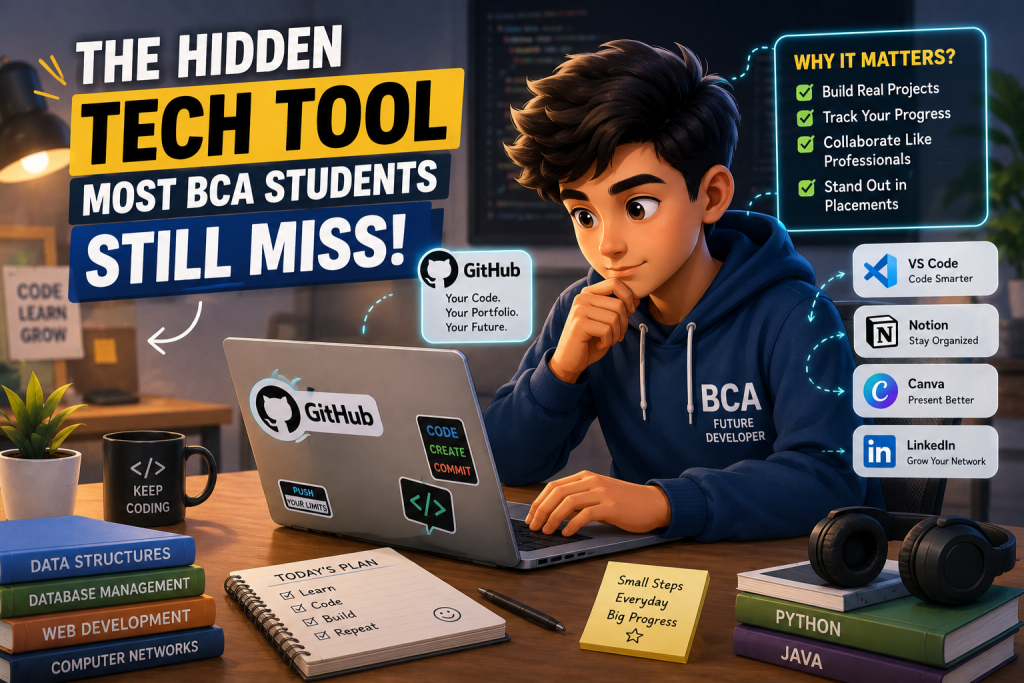
The Hidden Tech Tool Most BCA Students Still Miss: Git & GitHub
Among all the tools available for developers, Git and GitHub remain one of the most important yet commonly ignored platforms by beginners.
Many students discover it only during internship preparation or placement training, which is often too late to fully utilize its benefits.
Git and GitHub are not just tools—they represent how real software development works in the industry.
What is Git?
Git is a version control system used to track changes in code during software development.
In simple terms, Git helps developers:
- Save different versions of their work
- Track every change made in a project
- Go back to previous versions if needed
- Manage code efficiently without confusion
- Avoid losing important work during development
In professional environments, multiple developers work on the same project. Git ensures that their work remains organized and conflict-free.
Key Insight
Git helps students learn how professional developers manage and control real-world coding projects.
What is GitHub?
GitHub is an online platform that works with Git to store, manage, and share code projects.
It allows developers and students to:
- Upload coding projects online
- Collaborate with other developers
- Build a visible coding portfolio
- Contribute to real-world open-source projects
- Showcase work to recruiters and companies
Today, GitHub is widely used as a digital portfolio platform for developers.
Recruiters often review GitHub profiles to understand a candidate’s practical coding ability, consistency, and project experience.
Key Insight
GitHub acts as a professional portfolio that showcases real coding skills beyond academic marks.
Why Most BCA Students Still Ignore GitHub
Despite its importance, many students fail to use GitHub during their early learning phase.
Some common reasons include:
- Lack of awareness in early semesters
- Focus only on exams and assignments
- Fear of using technical tools
- No guidance on practical workflow systems
- Absence of project-based learning culture
As a result, students often complete their degree without understanding how real software development teams operate.
This gap becomes visible during internships and interviews.
Real-World Example: Why GitHub Matters
To understand the importance of GitHub, consider a simple scenario:
A student builds a project during college, such as a website or a small application.
- Without GitHub → The project stays stored only in a laptop folder and has no visibility
- With GitHub → The project becomes a public portfolio that anyone, including recruiters, can view
Now imagine two students applying for the same internship:
- One has only marks and certificates
- The other has multiple live projects on GitHub
Naturally, the second student appears more practical, skilled, and job-ready.
This is how GitHub silently creates a strong advantage.
How GitHub Helps BCA Students Become Industry-Ready
1. Builds a Strong Portfolio
Students can upload:
- Java projects
- Python applications
- Web development projects
- Mini software systems
- Database-based applications
This portfolio becomes proof of practical learning.
Key Insight
A strong GitHub portfolio can often make a bigger impact than academic scores alone.
2. Teaches Professional Workflow
Using GitHub helps students understand:
- How real development teams work
- How code is reviewed and updated
- How collaboration happens in projects
- How version control is managed
These are essential industry skills.
3. Encourages Consistent Practice
Since every project and update is visible, students are naturally encouraged to:
- Code more regularly
- Improve existing projects
- Experiment with new ideas
- Build learning consistency
Over time, this improves both skill and confidence.
4. Improves Placement Readiness
During interviews, students are often asked:
- Do you have projects?
- Can you show your work?
- Have you worked on real applications?
GitHub provides clear, practical answers to these questions.
Other Useful Tech Tools BCA Students Should Know
While GitHub is one of the most important tools, there are several other platforms that can improve productivity and career readiness.
Visual Studio Code (VS Code)
A powerful coding editor used widely in the industry.
It helps students:
- Write and debug code efficiently
- Use extensions for better productivity
- Work on multiple programming languages
- Manage projects smoothly
Key Insight
VS Code enhances coding speed, structure, and productivity for developers.
Notion
A productivity and organization tool.
Students can use it to:
- Organize notes
- Track project progress
- Plan study schedules
- Manage learning goals
Key Insight
Good organization improves learning clarity and reduces confusion during technical studies.
Canva
A design tool that helps students:
- Create presentations
- Design project reports
- Build visual portfolios
- Improve communication of ideas
Even technical students benefit from better presentation skills.
A professional networking platform that is often ignored by students early on.
It helps students:
- Build professional identity
- Connect with recruiters
- Discover internships
- Follow industry updates
- Showcase achievements
Key Insight
LinkedIn helps students build a professional presence even before graduation.
Why Practical Exposure Matters in BCA
Modern technology education is not just about learning concepts—it is about applying them.
Students who only focus on theory often struggle in real-world scenarios, while students who practice tools, build projects, and explore industry workflows adapt more easily.
This is why many institutions are now focusing on:
- Project-based learning
- Industry exposure programs
- Coding labs
- Technical workshops
- Hackathons and innovation challenges
Such environments help students bridge the gap between academics and industry expectations.
Key Insight
Practical exposure transforms classroom knowledge into real-world professional capability.
How Students Can Start Using These Tools
Students do not need advanced knowledge to begin.
A simple roadmap:
- Create a GitHub account
- Start uploading small coding projects
- Learn basic Git commands
- Use VS Code for coding practice
- Organize study notes in Notion
- Build a LinkedIn profile
- Keep improving projects gradually
Small consistent steps lead to long-term growth.
Key Insight
Consistency in practical learning is more important than mastering everything at once.
Conclusion
Many BCA students spend years learning programming languages but miss out on tools that are actually used in the real software industry.
Among them, Git and GitHub stand out as one of the most important yet overlooked platforms. They help students build portfolios, manage projects professionally, and understand how real development teams work.
Along with this, tools like VS Code, Notion, Canva, and LinkedIn also play a significant role in improving productivity, communication, and career readiness.
In today’s competitive tech world, success is no longer defined only by academic knowledge. It is defined by how effectively students can combine learning with practical tools and real-world application.
Ultimately, the students who start using these tools early don’t just study technology—they begin to experience how technology actually works in the real world.
Frequently Asked Questions (FAQs)
1. Why is GitHub important for BCA students?
GitHub helps students build portfolios, manage projects, and showcase real coding skills to recruiters.
2. Is Git difficult for beginners?
No, basic Git concepts are simple and can be learned with practice.
3. Can GitHub improve placement chances?
Yes, it helps students demonstrate practical experience and project work during interviews.
4. What other tools should BCA students learn?
Students can learn VS Code, Notion, LinkedIn, Canva, and basic cloud tools.
5. Why are tools important in BCA?
Tools help students understand real industry workflows, improve productivity, and become job-ready.
About the Author